
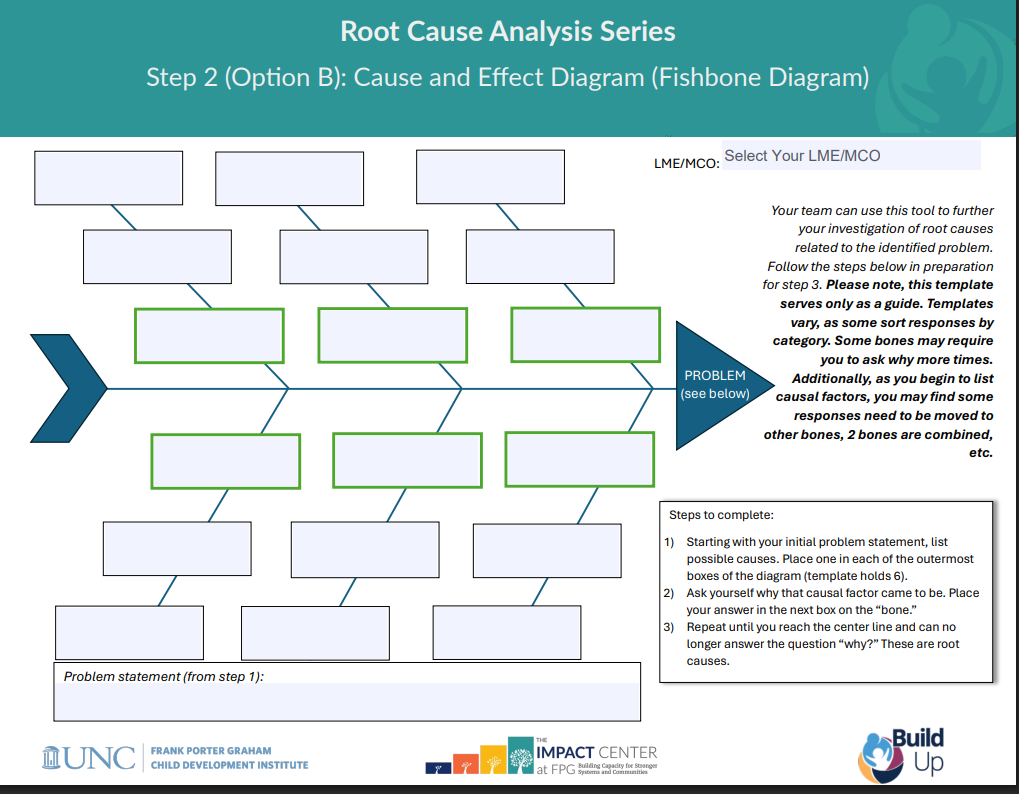
Root Cause Analysis Series- Step 2 (Option B): Cause and Effect Diagram (Fishbone Diagram)
What is this?
In this handout you’ll learn that there are several methods and associated tools for the process of root cause analysis, each with a unique set of benefits, drawbacks, and situations where its use is more appropriate. Also known as a fishbone diagram, “the cause and effect diagram was designed to sort the potential causes of a problem while organizing the causal relationships.1” Teams can use this tool to further investigate root causes related to the identified problem.
The steps in this toolkit are:
Step 2: Problem Exploration (An introduction to causal analysis is provided, alongside 3 options for completion)
Step 3: Implementing Solutions
Step 4: Testing Chosen Strategies
1 Doggett, A. M. (2005). Root Cause Analysis: A framework for tool selection. Quality Management Journal, 12(4), 34–45. https://doi.org/10.1080/10686967.2005.11919269
Why is this important?
As a continuation activity from earlier steps you can use this diagram to dive deeper into your problem and it’s causes.
Implementation Area: Exploration, Getting and Using Data
Stage: Exploration/Building Readiness